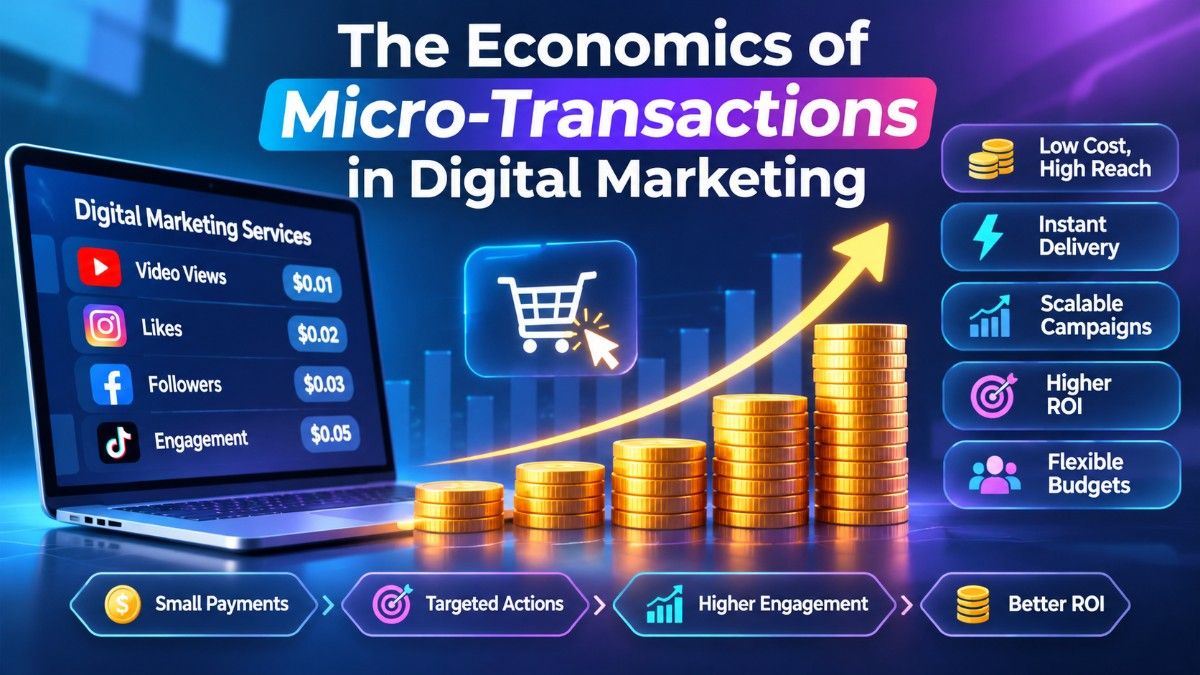
1. The Unit Economics of Fractional SMM Fulfillment
Unlike traditional agency deliverables—such as website builds or monthly video retainers billed in tens of thousands of rupees—social media engagement operates at a granular unit level. Wholesale services are priced per 1,000 units (Cost Per Mille), often starting at just a few rupees per thousand views or likes.
When a client or drip-feed schedule dispatches an order for 100 Instagram likes or 500 Reel views, the actual wholesale deduction might be ₹0.35 or ₹1.20. Individually, these pennies look tiny. However, when a reseller storefront or agency dashboard processes 3,000 automated micro-orders per day at a 150% retail markup, those fractional spreads compound into substantial, predictable monthly net profit.
2. Why Per-Order Gateway Fees Destroy Micro-Margins
The biggest threat to micro-transaction profitability is payment processing friction. Traditional e-commerce checkout rails (particularly international cards or PayPal) charge a percentage fee plus a fixed per-transaction surcharge.
3. The Pre-Funded Wallet Ledger: Decoupling Funding from Execution
Wholesale SMM infrastructure solves the micro-transaction paradox by decoupling **capital settlement** from **order execution** through a pre-funded internal ledger.
Instead of authorizing a bank transaction every time an order fires, agencies fund their master wallet in consolidated INR batches via zero-fee domestic UPI rails. Once the capital sits inside your dashboard ledger, the database can deduct fractional amounts—down to four decimal places (e.g., `₹0.0845`)—instantly and internally across thousands of sub-orders with zero banking latency or gateway fees.
4. Eliminating Labor Overhead with Programmatic APIs
The second law of micro-transaction economics is that **human hands must never touch a ₹5 order**. If an account manager spends three minutes copying, pasting, and tracking a micro-order, the cost of their salaried time exceeds the profit of the transaction itself.
By linking your retail panel or internal agency tracker directly to our REST API endpoints:
- Zero-Cost Dispatch: Orders transmit machine-to-machine in milliseconds without human intervention.
- Automated Partial Reconciliations: If a micro-order partially completes, the API automatically calculates and credits the exact fractional rupee remainder back to your ledger.
- Infinite Scalability: Whether your system dispatches 50 micro-orders a day or 50,000, your operational labor cost remains fixed at zero.