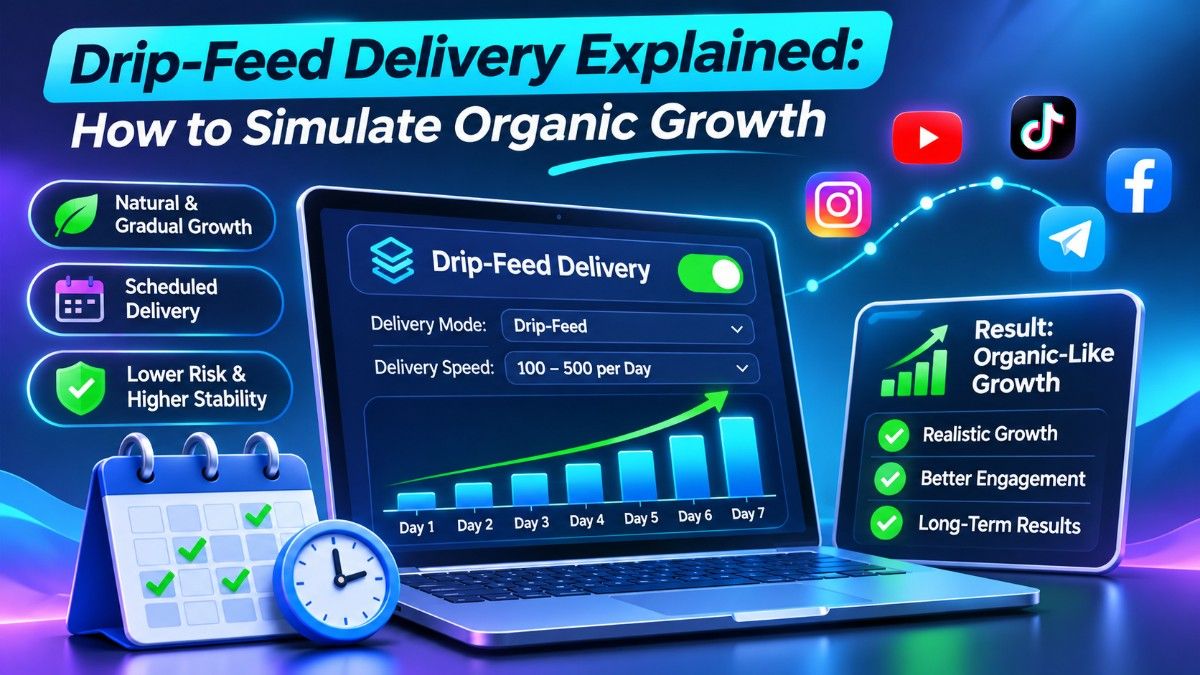
1. The Algorithmic Danger of Instant Metric Spikes
Social media recommendation engines—across Instagram, YouTube, LinkedIn, and X—constantly evaluate the ratio between an account's historical baseline reach and its incoming engagement velocity.
When a brand-new profile with 300 followers suddenly receives 15,000 followers or likes within a 10-minute window and then drops back to zero activity for the rest of the week, the statistical graph forms a vertical spike. Not only does this alert platform anomaly detection classifiers, but prospective brand partners checking analytics tools (like SocialBlade) can immediately spot the unnatural jump.
2. How Drip-Feed Architecture Works: Runs, Intervals, and Totals
Instead of requiring an account manager to sit at a desk and place a new small order every two hours, the **Drip-Feed** toggle inside your wholesale panel automates the entire scheduling sequence using three simple parameters:
- Quantity (Per Run): The exact number of followers, likes, or views you want delivered in each individual micro-batch (e.g.,
250). - Runs: How many times you want that batch repeated (e.g.,
20 runs). - Interval (in Minutes): The waiting time between each batch (e.g.,
60 minutes). - Total Quantity: The dashboard automatically multiplies
250 × 20 = 5,000 total units, paced smoothly over 20 hours.
3. Matching Delivery Pacing to Platform Discovery Curves
Every content format has a unique organic half-life. Engineering believable social proof requires aligning your drip-feed intervals with how real users consume content on each network:
- Instagram Posts & Reels (First 3 Hours): Meta's algorithm tests new uploads aggressively during the initial 180 minutes. Configure a fast, concentrated drip-feed—such as 6 runs of 150 likes every 30 minutes—to clear initial cohort benchmarks and push the post toward the Explore page.
- YouTube Long-Form Videos (24 to 72 Hours): Search and Suggested video traffic builds gradually over days. Use wider intervals—such as 12 runs of 500 high-retention views every 180 minutes—to sustain steady click-through momentum.
- Profile Follower Growth (7 to 30 Days): When scaling a corporate brand's follower count, set a 1,440-minute interval (24 hours) across 15 to 30 runs so the account gains a natural 100 to 300 followers every single day.
4. Using Drip-Feed to Automate 30-Day Client Retainers
Beyond algorithmic safety, drip-feed delivery is a massive time-saver for agency operations. When a client signs a monthly growth retainer on the 1st of the month, your fulfillment manager does not need to log in daily to drip out their follower package.
By configuring a 30-run order with a 1,440-minute (daily) interval on Day 1, the wholesale server automatically dispatches each daily batch in the background for the entire month—allowing your team to manage dozens of client retainers on complete autopilot.